


For years sociologists, anthropologists, and psychologists have mourned the loss of traditions marking important childhood "rites of passage." In earlier American culture, movement toward adulthood was accompanied by more ritualistic, meaningful celebrations of transition to newfound independence and responsibility to the family and community.
In an increasingly complex, dispersed, and fast-paced society, summer camp remains one of the final frontiers for young people seeking formal affirmation of advancing maturity and, ultimately, initiation into adulthood. Through structured, goal-
oriented activities taught and supervised by authority figures and role models, children at camp benefit from communal observance of achievement — whether in small-group or all-camp settings.
Nurturing Good Behavior
These are not insignificant observations for parents seeking for their children environments that are both rife with opportunities for growth and nurturing of behaviors that hold the promise of making poor choices less likely. Indeed, absent reasonable recognition of their early milestones, many young people seek alternative routes to "maturity," including drinking, drugging, dangerous driving, and early intimate sexual behavior.
Partnering With Parent — Youth Development at Summer Camp
The truth is that while parents offer the first, best shot of positively influencing youth, other influential adults may offer the best, last shot. Where's the proof? Working in tandem, parents and camp professionals have achieved success toward realization of the critical youth development goals identified by ACA in Directions: Youth Development Outcomes of the Camp Experience.

In a study of more than five thousand families from eighty ACA-accredited camps conducted between 2001 and 2004, parents, camp staff, and children reported significant growth in many of these important areas.
Sense of Self
The value of childhood gains in identity, independence, and peer relationships is similarly highlighted in a SADD/Liberty Mutual Teens Today study linking each to an overall "Sense of Self." That report found that young people with a high Sense of Self more often report feeling smart, successful, responsible, and confident than do their low Sense of Self counterparts. They also more frequently cite positive relationships with parents and are more likely to avoid alcohol and drug use. Of course, parental involvement strongly correlates with teens' Sense of Self and the decisions they make.

Just as important, the data points to the value of the summer camp experience and the role that counselors play in positively enhancing a child's Sense of Self by:
- Supporting a wide sampling of interests, activities, and age-appropriate behaviors;
- Encouraging separation from parents and age-appropriate independence in decision-making; and
- Teaching peer-to-peer social skills and facilitating (positive) peer relationships.
Positive Risk-Taking
Also corroborating the efficacy of ACA's findings is SADD/Liberty Mutual data suggesting that young people who take the very types of positive risks that camps promote are 20 percent more likely to avoid destructive behaviors than are those who do not. They are also more likely to describe themselves in positive terms and to report they often feel happy.
Adult Inattention
Despite overwhelming evidence of the saliency of adult attention, a new Teens Today report from SADD and Liberty Mutual Group reveals that almost half of high school teens say that their mom and dad miss the boat when it comes to communicating about and recognizing or celebrating what they consider to be meaningful life events during their adolescence. Not surprisingly, these teens are more likely to engage in destructive behaviors.
According to the study, high school teens whose parents pay the least attention — 42 percent — to significant transition periods, such as puberty, school change, and key birthdays, are more likely than teens whose parents pay the most attention — 18 percent — to engage in high-risk behaviors such as alcohol and drug use. They are also more likely to engage in early sexual activity.
The Teens Today research also highlights the effect of attention on another significant teen rite of passage: driving. For example, teen drivers who report high levels of parental attention are significantly more likely than those who report low levels of parental attention to say they never speed (45 percent vs. 14 percent). The data also suggests that these teens are more likely to wear seat belts while driving and are less likely to drive while impaired or to ride in a car with an impaired driver.Mental Health
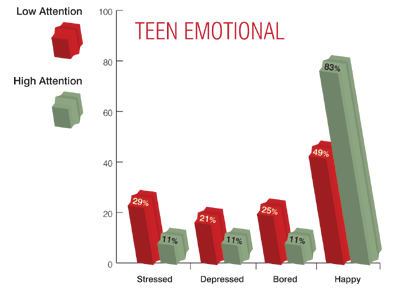
Young people who receive the least attention also appear susceptible to feelings of boredom and depression and are more than twice as likely to report daily stress. Conversely, teens who receive the most attention are significantly more likely to say they feel happy every day or almost every day.
What About Younger Children?
While younger teens also report inattention (fewer than one in three middle school students cites high levels of attention), they tend to fare better than their high school counterparts. This trend supports the thesis that a "pseudo-maturity" imposed on older adolescents, in part by a society that applies an ever-pervasive pressure to succeed, leads even the most caring of adults to doubt the necessity of paying much attention to growing teens.
Along with a shorter childhood, ushered out by a typically younger onset of puberty, and an extended adolescence, ushered in by an increasingly protective culture and elongated academic preparation, this detachment has brought about a vast, vague period of human development. It is during this time, more than ever before, that young people seek out acceptance into adulthood, anxious to demonstrate their almost-adult status.
Other Significant Adults
While young people need, and desperately want, their parents to pay adequate attention to the "important" things (some say their parents pay too much attention to the "wrong" things), they also look to other important adults as barometers of their progress in an uncertain world. Much of what they think of themselves during this critical transition phase is a direct reflection of how they believe others — including their camp counselors — perceive them. That is precisely why camp staff is uniquely empowered to satisfy at least some of the attention needs of children as they climb the ladder toward adulthood, conquering a seemingly endless array of developmental "tasks" along the way.
Rites of Passage and Summer Camps
There are three important ways in which summer camps — and their staffs — can help young people enjoy safe, healthy rites of passage.
First, they can recognize key adolescent life-transitions. Counselors can aid teens in building bridges between whom they were, whom they are, and whom they are becoming. In turn, those connections help teens to crystallize their search for identity and purpose, preparing them for a less egocentric, more collectivist role in society.
Secondly, they can encourage campers' participation in activities embedded with opportunities of measurable progression toward accomplishment of standardized achievements (e.g., awards) or goals (e.g., completion of projects).
Finally, they can offer unique opportunities for increased responsibility — especially for younger campers — they may not have elsewhere and that carry with them inherent feelings of maturity and independence.
Tradition and Ceremony
Summer camps are chock-full of meaningful age-related traditions — and accompanying ceremony — that help young people to mark progress while demonstrating to others that they are, in fact, growing up. Traditional recognitions of passage link generations through tangible representations of physical, and sometimes subtle, social and emotional change.Advances and Retreats
Easier said than done? For sure. Actually pinpointing when transitions have taken place can be tricky.
In an adult narrative describing the experience of youth, Kevin Arnold, the principal subject of the 90s hit television show The Wonder Years, noted, "Growing up is not so much a straight line as a series of advances and retreats." This is a keen observation on adolescent movement toward adulthood.
Most people tend to think of maturation as linear, beginning at point A and ending at point Z. In reality, as young people mature they move back and forth along a continuum of growth, showing demonstrable signs of progress one day, only to awaken the next seemingly further behind. This phenomenon marks both their uncertainty with all things new (physical, social, and emotional) and their antipathy toward the whole developmental process to begin with.
Understanding that movement and the context in which it occurs is critical in recognizing the challenges teens face in their daily lives and what may or may not constitute important passages.Identify significant teen transitions.
Important transitions in adolescence can be a one-time thing, such as a first date, first job, or first driver's license, or the gradual progression toward maturity. Figuring out which transitions are most important to your camper is a critical first step in helping him or her transition to adulthood. What "counts" for one young person may not matter much to another. Here are some things to keep in mind:
- Tune in to the things that seem important in his daily life.
- Notice how she spends her days so you can flag changes.
- Ask how he feels about different transitions.
- Note how she talks about transitions with friends.
- Talk about important transitions in your own adolescence.
- Watch for signs of happiness, joy, stress, anxiety, or depression surrounding change.
Communicate about and recognize or celebrate important life events.
Sending the message that you are "dialed in" to your campers as they take significant steps along the path to adulthood is an important way to say, "I care about you, and I hear you!" Teens look for signals that they are making real progress toward becoming adults and care very much what you think about them, even if they don't always show it. Here is what you can do:
- Talk regularly — and casually (they hate "the big talk") — about the transitions you see them tackling.
- Recognize these transitions through small privileges, words, or deeds.
- Celebrate group transitions with a pizza party, special activity, or assembly talk.
Growing Up in the Twenty-First Century
In a culture largely devoid of formal "rites of passage," and too often unobservant of the few that exist, young people may make up their own. Far too frequently they include drinking, drugging, and other potentially destructive behaviors. By paying attention to the important transitions of childhood and adolescence, influential adults — including camp professionals — can make it less likely that poor choices will become a child's self-constructed mileposts along the path to adulthood.
Encouragingly, six years of SADD/Liberty Mutual research make clear the incredibly influential role that caring adults can play in guiding young people toward safe, healthy choices. This latest report provides even clearer examples of how — underscoring the payoff for paying attention.
© Summit Communications Management Corporation • 2006 All Rights Reserved
| Teens Today is an annual study sponsored by SADD (Students Against Destructive Decisions) and Liberty Mutual Group of adolescent attitudes and behaviors. This unique coupling of a national nonprofit youth peer-to-peer education and prevention organization with a Fortune 500 insurance company has yielded a body of work widely recognized as an important barometer of the world in which our teens live and of the challenges they face.
The Teens Today methodology, implemented by Atlantic Research & Consulting, Inc. (2000-2005) of Boston and Roper/ASW of New York (2003) included both qualitative research (focus groups and/or in-depth interviews) in Atlanta, Boston, Charlotte, Chicago, Dallas, Denver, Houston, Los Angeles, Miami, Minneapolis, New York, Phoenix, San Diego, San Francisco, Seattle, and Tampa and quantitative surveys administered to more than 10,000 middle and high school students — and almost 2,000 parents — nationwide. More information about Teens Today research can be found at www.sadd.org and www.libertymutualinsurance.com. |
Stephen Wallace, M.S.Ed., national chairman and chief executive officer of SADD, Inc. (Students Against Destructive Decisions), has broad experience as a school psychologist and adolescent counselor. He directs the annual Teens Today research project, a partnership of SADD and Liberty Mutual Group, serves as an adjunct professor of psychology at Mount Ida College, and is director of counseling and counselor training at the Cape Cod Sea Camps in Brewster, Massachusetts.
Originally published in the 2006 May/June issue of Camping Magazine.

