


When people hear the word “coaching,” they often picture someone with a whistle and a clipboard directing players from the sidelines. Coaching in the cabin looks different, because it is different! It is not about giving answers or controlling outcomes. It is about guiding thinking that helps campers develop skills that build lasting confidence.
In the daily rhythm of camp life, as counselors you move fluidly among many roles. At different moments, you are instructors, caregivers, referees, problem solvers, and role models. Much of the day is spent giving directions, teaching skills, and setting boundaries. But you will likely find that some of the most impactful moments happen quietly, in the cabin, on a bench outside the dining hall, or along a path between activities, when a camper comes forward with a problem they don’t yet believe they can handle on their own.
- “Those kids aren’t being fair.”
- “They didn’t give me a turn.”
- “They won’t let me play with them.”
If you have worked at camp before or been a camper yourself, these moments are familiar. They often come charged with emotion and urgency. A camper may feel frustrated, hurt, or overwhelmed. The instinctive response for many of us is to fix the situation — we ask questions, promise to talk to the other campers, or step in to manage the interaction ourselves.
This impulse comes from a good place. We want campers to feel better quickly, we want the conflict to stop so the day can move on, and we believe we are the person to do it. But when we consistently solve problems for campers, we unintentionally send a message that they are not capable of handling challenges themselves. We also miss opportunities to teach skills that matter far beyond camp.
Bringing a Coaching Lens More Intentionally Into Camp
The coaching you are learning about here is something different than what you might have experienced with your athletic coach growing up. The business world and individuals seeking to achieve higher performance in life have long sought out different types of coaches — leadership coaches, life coaches, relationship coaches.
So while coaching outside of sports itself is not new, bringing coaching to campers using a time-tested professional coaching model actually is. You have the chance to be one of the first to do so!
The same reasons people seek out coaches in their personal and professional lives translate naturally to camp, which provides constant, real-time opportunities for young people to practice communication, decision-making, and emotional regulation within strong relationships. Using coaching can give language and structure to what you are already trying to do: help campers grow and become more confident and capable in life.
So now that we’ve established that coaching offers a different approach than traditional problem-solving, let’s take a look at a highly effective professional coaching model that you can use with your campers this summer.
What Coaching Is Not
Coaching is not ignoring campers when they are upset. It is not refusing to help. It is not letting problems linger unchecked.
Coaching is an active and engaged process. You are listening closely, asking intentional questions, and staying present while campers think through and take action for themselves.
Support doesn’t disappear. It simply looks different.
This distinction matters. Coaching means standing alongside a camper rather than stepping in front of them, an approach that feels both supportive and manageable. If you trust the process and yourself, you’ll see that this kind of coaching isn’t about doing nothing; it’s about doing the right thing at the right time.
Helping Campers Grow Using the GROW Model
The GROW model is a widely used coaching framework in leadership development, education, and corporate settings. Executive coaches, managers, and educators use it because it offers a simple, repeatable structure for helping people clarify goals, understand reality, explore options, and commit to action. Rather than focusing on advice or correction, the model emphasizes ownership and accountability (Whitmore, 2009).
Instead of fixing problems for campers, the GROW model helps campers develop the skills to handle challenges on their own within a supportive environment. It shifts your role as counselor from problem solver to guide.
Many camp conflicts are not emergencies. They are potential learning moments. Coaching allows you to slow those moments down and turn them into opportunities for growth and autonomy rather than dependence.
The GROW model provides an accessible structure that you can rely on in emotionally charged situations to help you resist the urge to jump straight into fixing a situation.
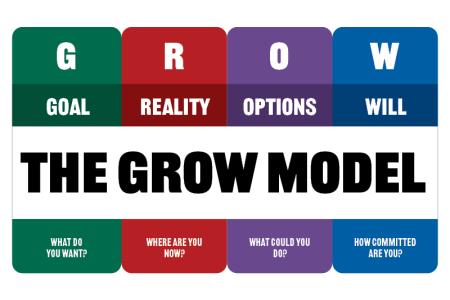
G Is for Goal: What Do You Want?
In a typical interaction, you might move quickly to solutions.
- “Have you tried sitting with them anyway?”
- “Why don’t you play with someone else?”
- “Let me go talk to them.”
A coaching approach starts somewhere else, by helping the camper identify their goal.
You might ask, “What do you want to happen here?” or “What would make this situation better for you?”
Often, the answer reveals something deeper than the immediate complaint. A camper may say, “I want them to include me,” “I want to be friends with them,” or “I just want to feel like I belong.” Naming the goal shifts the conversation away from blame and toward intention. It gives direction and helps the camper begin to think more clearly.
R Is for Reality: What Is Actually Going On?
Once the goal is clear, the next step is to explore the reality of the situation. This is not about you gathering information to decide what to do. It is about helping the camper lay out the full picture for themselves.
Questions might include:
- “What has already happened?”
- “What have you tried so far?”
- “Who was there and what was said?”
The camper may describe specific moments. They asked to join a group playing a card game and were told no. Later, the same group walked ahead to lunch and said they were having a private conversation. The lone camper may add, “I already tried asking,” or “I talked to someone, and it didn’t work.”
As you listen, it can be tempting to interrupt with solutions or judgment. Coaching requires restraint. The purpose of this step is to help the camper reflect, organize their experience, and recognize patterns. Simply talking through the reality often reduces emotional intensity and helps campers move out of a reactive state.
O Is for Options: Expanding What Is Possible
Once the goal and reality are clear, the conversation can shift to options. This may be the hardest moment for you to stay in a coaching role.
Instead of offering suggestions immediately, invite campers to generate their own ideas. A simple question like, “What are some things you could try from here?” opens the door.
Some campers will respond quickly. They might suggest asking to join a game before it starts, inviting others to play something new, or choosing a different moment to approach the group. Other campers may struggle and say they have no idea what to do.
Rather than filling the silence, you can keep the thinking going by asking, “What else could you try?” or “If you had to come up with one more idea, what might it be?” Some coaches encourage campers to come up with three to five options, even unrealistic or silly ones. The goal is not to find the perfect answer, but to stretch their thinking. This is about expanding possibilities — which in turn helps develop critical-thinking skills. When campers generate multiple options, they stop seeing the situation as all or nothing. They learn that by engaging in expansive thinking, there are many ways to approach a challenge.
There is an important boundary in this stage. When a camper suggests, “You could talk to them for me,” it helps to think about how coaching works in sports. A coach does not step onto the field to run the play for the athlete. The athlete has to be the one who takes action. In the same way, coaching in the cabin keeps the focus on actions the camper can take themselves, rather than having a counselor step in and do it for them.
Only after the camper has exhausted their own ideas does it make sense for you to offer a suggestion, and even then, it should be framed as one option among many.
W Is for Way Forward: Turning Insight Into Action
The final step of the GROW model is where insight becomes movement. Some versions of the model refer to this step as “will.” Others call it “way forward.” In a camp setting, the emphasis is on commitment and follow-through.
You might ask, “Which of these options do you want to try?” or “Which one feels like it has the best chance of working for you?” The choice belongs to the camper.
Once an option is selected, you should encourage campers to name a specific timeframe. Specifying “after lunch,” “during free play,” or “before rest hour ends” turns intention into action and reduces avoidance.
You can also offer support without taking over. You might ask, “Do you want to practice what you are going to say?” or “Would it help to check back in afterward?” Follow-up isn’t about policing success. It’s about accountability and encouragement. Knowing someone is in their corner makes a difference.
This stage helps campers clarify and commit to a plan by answering five key questions:
- What will you do? The action should be clear and concrete.
- When will you do it? Naming a time creates accountability.
- How will you do it? This is where you can offer support such as role-playing or planning language without taking over.
- What might get in the way? Anticipating obstacles builds resilience.
- How committed are you? If commitment feels low, the plan can be adjusted to be more doable.
If the plan doesn’t work, the camper has a place to return, reflect, and try again. Over time, this process becomes internalized. Campers begin to approach challenges with greater confidence and resourcefulness.
Insight feels good. Action is what builds confidence.
Why Coaching Matters for You
Coaching is not only beneficial for campers. It is essential for you.
Counselors who spend their days fixing every issue often feel exhausted and overwhelmed, leading to rapid burnout. Coaching shifts the role from problem solver to guide. It allows you to support growth without carrying the emotional weight of every outcome.
Coaching also builds your leadership skills. You get practice in listening deeply, asking thoughtful questions, and managing emotional situations without becoming reactive. These skills translate far beyond camp.
Coaching in the Cabin Builds Confidence for Life
When you consistently use a coaching approach, something powerful happens. Campers learn how to identify what they want, understand what is really happening, think creatively about options, and take action with support.
Coaching in the cabin doesn’t mean doing less for campers. It means teaching them more. When you coach instead of fixing, you’re not just resolving today’s conflict; you’re helping campers build skills they will use long after the summer ends.
Photos courtesy of Camp Summit, Paradise, TX; Skyline Camp and Retreat Center, Almont, MI.
Reference
Whitmore, J. (2009). Coaching for performance: GROWing human potential and purpose. Boston, MA: Nicholas Brealey Publishing.
Allison Corey Miller is a board-certified executive coach, veteran camp director, and CEO of Happy Camper Live. With more than 25 years of experience leading summer camps and developing staff, Allison focuses on coaching-based leadership that supports confidence, independence, and resilience in campers and counselors. As a cofounder of Summer Camp Coaching, she works alongside camp professionals to shift leadership approaches from reactive problem-solving toward intentional skill development. Her work connects camp operations, staff training, and life skills in ways that support growth well beyond the summer season.
Jeff Leiken, a master practitioner of NLP and cocreator of the HeroPath program, helps young people overcome challenges through unconventional methodologies. As the author of Adolescence Is Not A Disease and a popular keynote speaker, he has trained over 60,000 parents, teens, and professionals. With a master’s in educational counseling, Jeff is known for his passion, depth of knowledge, and captivating storytelling.
Erica Hruby, a tween/teen expert with 30+ years of experience, helps parents and professionals (from diverse industries) who work with tweens and teens to strengthen relationships and collaboration through education and coaching. Erica’s enthusiasm for teaching coaching strategies to camp professionals has illuminated untapped potential and provided new language to the field. A professional educator, speaker, and curriculum developer, Erica holds a master’s in clinical psychology.

