

I went to the Double H Ranch Sleepaway camp for seven years, starting at age 12. It’s near Lake George in upstate New York. We did a ton of fun stuff like swimming, archery, a talent show, dancing, campfires, a trip to an amusement park, and a zip line.
Double H (which is part of the SeriousFun Network) is also completely wheelchair accessible — which is good because I’m a wheelchair user. I’ve had a movement disorder, epilepsy, and a swallowing disorder my entire life due to my GNAO1 neurodevelopmental disorder.
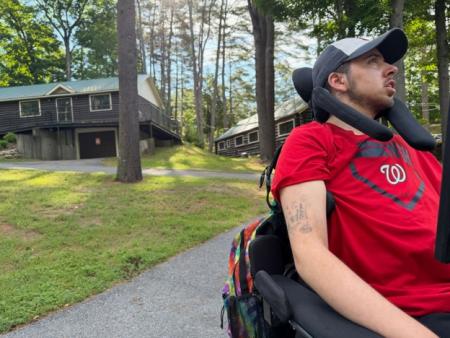
At camp, I felt totally free and accepted for who I am. Nobody judged me. Nobody underestimated me. A few years ago, I even got a Double H tattoo.
Now through my film work, I want to show young people that everyone can live a full life with a disability. That’s why we are giving out our Emmy®-Award winning films The Ride Ahead and My Disability Roadmap for free to nonprofit camps and summer programs all over the country in a free screening kit with a discussion guide.
Telling My Story
I’ve lived in Concord, New Hampshire, my whole life, and the schools are very inclusive for students with disabilities.
Being included in regular classes really made a difference in my education and social life. I learned the general curriculum. I played Unified Sports and was part of the school TV station: I did the Red Sox and New England Patriots report each week. I was also on the yearbook staff and the school newspaper. I graduated from Concord High School in 2018 with a high school diploma.
But then things felt confusing after I graduated. I wanted to go to college. Date. Get a job. Live on my own.
But no one tells you how to be an adult — let alone an adult with a disability.
I felt stuck. And lonely. And my health is so unpredictable. One minute I can be getting dressed for the day, and the next minute my body can go into crisis and I’m racing to the emergency room.
How do I do this adulting-while-disabled thing?
I suggested an idea to my dad, who is a filmmaker. How about I interview badass adults with disabilities about their transition to adulthood?
I wanted to talk to disability activists like Judy Heumann, Bob Williams, and Keith Jones — people I have looked up to for years. I also reached out to other advocates, like Ali Stroker, Maysoon Zayid, Andrew Peterson, and Lydia X.Z. Brown. How did they find their roadmaps?
I knew they’d all be honest and tell it like it is. My dad and I filmed these interviews all around the country over three years, while I filmed my own life from my perspective with two Go Pro cameras mounted on my wheelchair.
I learned from my mentors that it’s not easy to be an adult with a disability. But one of the best pieces of advice I got was from Zayid, a comedian and actor. She said, “You are not alone. Find your community.” Being a part of the Double H community helped me feel much more confident in myself. I also found community by enrolling in my local community college, and in the disability community. I also work for a local concert venue in Gilford, NH, where I scan tickets, and then get to attend the shows for free after my shift ends! It’s great people watching — and it feels good to earn money.
Our films My Disability Roadmap and The Ride Ahead are now being shown all over the world. More than anything, I want to use our films to make sure other young adults with disabilities have the same opportunities that I've had for health care, inclusive education, college, assistive technology, jobs, making friends and independent living.
And I hope the films show everyone that they should not talk down to people with disabilities. Treat us with the respect and high expectations we deserve.
When they see our films, I hope that the millions of young adults with disabilities will feel more seen, find their own mentors, and create their own roadmap. And I hope their roadmaps include going to a camp where they can feel like they belong.
Photos courtesy of LikeRightNow Films
The views and opinions expressed by contributors are their own and do not necessarily reflect the views of the American Camp Association or ACA employees.


