


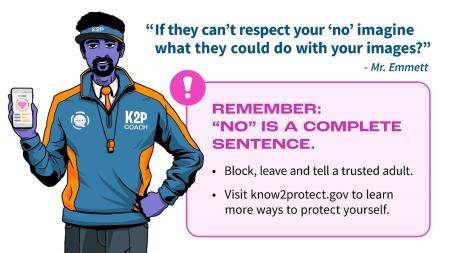
Kids and teens are increasingly being pressured online to share explicit photos and to engage in harmful activities. Camp counselors and staff can help by reinforcing a simple online safety skill: “No” is a complete sentence.
Kids and teens are facing mounting pressure online to share explicit images and engage in harmful behavior. From sharing nude images and participating in dangerous social media “challenges” to being targeted for financial sextortion, the risks are escalating. Last year, about one in three young people under the age of 18 reported being asked to share sexual imagery of themselves by someone they had met online, while one in six have shared sexual imagery of themselves (Thorn, 2025). At the same time, generative artificial intelligence (GenAI) is fueling the rapid spread of deepfake images used to create child sexual abuse material — often without a young person’s knowledge or consent.
These trends are reflected in the exponential rise in reports to the National Center for Missing and Exploited Children (NCMEC), which grew from 1 million in 2014 to more than 20.5 million in 2024 — a 1,990 percent increase in a decade (NCMEC, n.d.). In 2025, financial sextortion reports increased by 70 percent, online enticement reports increased by 77 percent and GenAI reports soared by 6,343 percent.
The urgency is clear: Trusted adults must understand the evolving threat and be equipped with practical tools to help young people navigate online risks with confidence.
How2Respond
Camp counselors and staff are often trusted adults that kids can turn to for guidance. Without support, youth may feel unsure how to respond to online pressure, fearing conflict or consequences if they speak up. Teaching kids and teens that they don’t need to explain, justify or negotiate their boundaries online helps build confidence and reinforces personal agency. Whether declining a request for personal information, refusing to share photos or leaving a questionable conversation, the ability to say “no” clearly and confidently is a critical online safety skill all kids and teens need to be taught. Pairing these conversations with age-appropriate, practical tools help young people recognize risks and respond effectively.
The Know2Protect® campaign offers age-appropriate resources to explain how peer-on-peer interactions can quickly cross into criminal activity and help youth understand the consequences. The Exit Strategy checklist provides concrete steps for leaving uncomfortable or risky situations online. Share these resources with campers:
- How2Spot Peer-on-Peer Risks: A Guide for Tweens | Homeland Security
- How2Spot Peer-on-Peer Risks: A Guide for Teens | Homeland Security
- Exit Strategy Checklist | Homeland Security
References
Davis, P. (2025, September 4). Spike in online crimes against children a “wake-up call.” National Center for Exploited and Missing Children. https://ncmec.org/blog/2025/spike-in-online-crimes-against-children-a-w…
National Center for Exploited and Missing Children. (n.d.). 2024 CyberTipline report. missingkids.org/gethelpnow/cybertipline/cybertiplinedata
Thorn (2025). Deepfake nudes and young people. info.thorn.org/hubfs/Research/Thorn_DeepfakeNudes&YoungPeople_Mar2025.pdf
The views and opinions expressed by contributors are their own and do not necessarily reflect the views of the American Camp Association or ACA employees.


