

The ACA Hotline Team is proud to have served the camp community for 40 years, offering confidential crisis support by providing resources and a calm third-party perspective when a camp in crisis is in need. The Hotline is available to any camp — regardless of their ACA membership or accreditation status — 24 hours a day, every day of the year.
While not legal or medical experts, the hotline team members are ACA staff with experience as camp professionals and can provide support when camps are facing a crisis. They often help callers identify where their own policies and procedures may help them find a way to address the situation.
Each year, ACA tracks the trends and lessons learned from the confidential calls received and provides an annual review of what was learned and case studies for camps to use in their own staff training and risk management planning. Our most helpful resources can be found online at Camp Crisis Hotline.
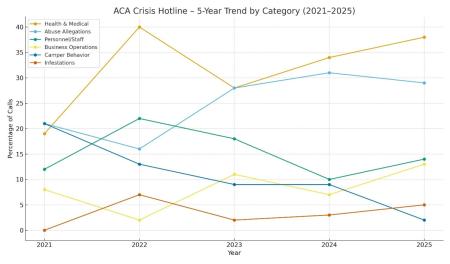
Across five years of ACA Crisis Hotline activity, the dominant categories have remained consistent — Health and Medical, Abuse Allegations, and Personnel/Staff issues. In 2025, Health and Medical remained the top call category (38 percent), while abuse allegations comprised 29 percent of calls. Overall, the five-year trend suggests:
- Health and medical calls remain elevated post-pandemic (30–40-percent range each year). Issues in this category range from illness and injury to all sorts of communicable diseases. While this represented the highest number of calls in 2022, 55 percent were COVID related, and the number of other calls aligned with the total number of calls in the previous year. We've included infestations in this category, representing an additional 5 percent of calls to the Hotline, as they typically also require a health-related response in addition to a business operational response.
- Abuse allegations show a long-term upward trend from 2022 to a peak in 2024, settling slightly in 2025. This second largest and most alarming category dealt with abuse issues nearly equally split in 2025 between camper-to-camper and staff-to-camper allegations.
- Personnel/staff concerns remain a steady operational challenge (10–22 percent). Camps calling with issues in this category overwhelmingly sought assistance with HR policies and procedures. Hotline team members discussed policies, incident reporting procedures, as well as reaching out to legal and insurance resources for targeted support.
- Business operations and communication issues continue to increase in visibility, reaching 13 percent in 2025. Calls in this category were wide ranging, from response to nature/weather-related emergencies to insurance coverage and the need for additional camp policies around staffing, supervision, and training.
- Camper behavior calls seem to have dropped significantly in recent years (from 21 percent in 2021 to 2 percent in 2025). While many calls involve camper behavior issues, they also fall into other categories requiring a specific response, such as allegations of abuse, and are thus included below.
Health and Medical Issues
Top 2025 Trends
- Some calls in this category were more "typical" following the COVID-19 pandemic
- Camper suicidal ideations and threats of self-harm, unexpected staff and camper fatalities
- Parent sending undocumented meds
- COVID; pneumonia; gastrointestinal-related illness; hand, foot and mouth; swimmers itch; ringworm; and lots of lice
- Helping campers/camp community deal with traumatic events (either at camp or camp adjacent) and the need for mental health resources
- Camper seeking pregnancy test, worried she might be pregnant
- Rules regarding EpiPens on site and the impact of medical staff shortages at camp
Key Five-Year Trends
- Pandemic-driven issues peaked in 2022, though camps continue to deal with issues related to communicable diseases at camp.
- Post-pandemic calls reflect the need for support around general illness management, medication, mental health, and infestations.
- The need for MESH and behavioral health support remains high, appearing in nearly all categories of calls to the Hotline.
Lessons Learned
- Strengthen your camp health system readiness.
- Ensure your policies for injury and illness management, medication protocols, and infestation response plans are up to date. Staff should be trained and prepared to implement your healthcare policies and procedures, including your plan to communicate with families, staff, and the broader community when needed.
- Identify key health and medical resources prior to the camp season. Develop a relationship with a network of mental health professionals to be on call or to support your camp community through the camp season.
- Develop consistent environmental health and infestation protocols including a stepwise decision-making process for suspected infestations (triage → containment → communication), and a relationship with a local pest-management service.
- Know the laws applicable to your camp's healthcare operations, such as those around parent notification and medication distribution in your state.
Resources
- Summer Resource Hub for Grieving Youth and Families
- Communicable Diseases and Infestations
- Mental Health Resources — Tips for Camps
- Mental, Emotional Social Health
- Alliance for Camp Health — Resources
- Infection Control
Abuse Allegations
Top 2025 Trends
- About two-thirds of the abuse allegations were related to campers, in particular camper-to-camper abuse.
- Surprisingly, among the 35 percent of calls involving staff, abuse was reported between a leadership staff member and underage staff member, and indications suggest these were not isolated incidents.
- These typically emotional calls often involve a camp's lack of policies.
Key Five-Year Trends
- Abuse allegations show a long-term rise, from a low of 16 percent (2022) to a peak of 31 percent (2024).
- The proportion of calls related to camper-to-camper abuse (two-thirds) reflects the national trend of 70–77 percent of sexual abuse involving minors. (Bunkmates and Boundaries: Understanding the Dynamics of Peer-to-Peer Behaviors at Camp | American Camp Association)
Lessons Learned
- Build robust abuse-response and mandated-reporting systems.
- Train staff annually on their responsibilities as mandated reporters, including identifying abuse, supervision and establishing clear boundaries, and reporting procedures.
- Develop transparent, trauma-informed protocols for both reporting and supporting affected campers/staff.
- Have clear policies outlining your abuse prevention and how your camp would respond to an allegation of abuse, including identifying supportive resources. Policies and procedures should be reviewed and updated annually.
Resources
- Childwelfare.gov — How to Report Child Abuse and Neglect
- CDC Child Abuse and Neglect Prevention — About Child Abuse and Neglect
- Child Abuse and Neglect Resources — Child Welfare Information Gateway
- Do Children Sexually Abuse Other Children? — Stop It Now
- A Culture of Safety Starts with You: A Frontline Staff Guide to Preventing Peer-to-Peer Abuse Among Campers | American Camp Association
- Recognizing and Reporting Child Abuse and Neglect | American Camp Association
- CampSafe® Child Sexual Abuse Prevention Training | American Camp Association
- Allegation of abuse resources may be found in one place on the ACA website
Personnel/Staff Concerns
Top 2025 Trends
- Most calls were related to staff behavior, including:
- Issues with staff drinking on camp property
- Reports of frustration with leadership staff
- Staff injury while driving a golf cart
Key Five-Year Trends
- Reports of personnel/staff issues piqued in the years immediately following the pandemic (2022–2023).
- Calls regarding staff behavior come from camps seeking resources to help them make decisions about inappropriate staff behavior.
Lessons Learned
- Formalize HR, supervision, and staff support systems.
- Ensure your camp has access to an employment legal counsel or HR professional.
- Establish and review annually clear HR policies including communication channels that provide the means to express supervisor concerns, and clear, consistent disciplinary pathways.
- Identify accessible mental health support access for staff.
Resources
- Employment Laws in Your State
- Best Practices with International Staff
- Criminal Background Check Resources
- Camp Leadership: Build, Grow, Sustain
Business Operations Issues
Top 2025 Trends:
- Severe weather, including flooding and nature-related crises
- Power/infrastructure problems
- Parent communications challenges, including an increasing trend of parents asking to review camp policies
- Regulatory uncertainty
Key Five-Year Trends
- Business operation issues are steadily increasing: 2% → 11% → 7% → 13% in 2025.
- This category represents a wide range of issues that interrupt business operations, from extreme weather to power outages, wildlife, insurance, and understanding laws and licensing requirements that impact camps.
Lessons Learned
- Create proactive response procedures and business-continuity plans.
- Understand the laws, rules, and regulations that impact your camp's operations. Take the time to annually review and update procedures to make sure that your camp's facility and operations meet those expectations.
- Develop a comprehensive crisis communications plan that includes pre-written communications for a variety of audiences, including parents, staff, board and other stakeholders, and the media.
- Establish risk-specific plans for utility issues, weather events, staffing, financial issues, or other issues specific to your campsite and operation. Staff and camper training and rehearsal should be included in these plans.
- Identify potential operational backups (transportation, refrigeration, staffing, etc.) and key resources prior to the camp season.
Resources
- Safety at Camp Resources
- State Laws and Regulations
- Camp Sustainability Toolkit
- Insurance Panel Discussion
- Key articles on camp insurance from ACA's CampLine and Camping Magazine publications
- ACA Communications Toolkit
- Messaging Manual for Camps
- Buckets to Explore: A Six-Step Approach to Bridging Your Business
- Weather Resources
- Wildfire Resources
Implications for Your Camp — Case Studies
Each year, the Hotline team assembles a collection of case studies based on actual calls to the Hotline from the previous year. These case studies provide opportunities for planning and staff training in consideration of the implications of these situations for your camp. As you review these case studies, consider:
- What would you do if this happened at your camp?
- Who would you get involved in the situation?
- What resources would you want and use?
- What "aha" moment has this provided for you?
- In your opinion, could this situation have been prevented? If so, how?
Case Study #1: When Safety and Violence Collide
Case Study #2: Blurring the Lines
Case Study #3: The Midnight Intruder
Case Study #4: Behind Closed Doors
Case Study #5: Balancing Inclusion and Safety
Case Study #6: Dangerous Words
Case Study #7: Quarantine Quandary
Case Study #8: Lice Lessons
Case Study #9: Troubled Waters
Wrapping Up: Foundations of Crisis Preparation
While so much can change over the course of 40 years, the unmistakable value of learning from experience and using unexpected situations to plan for the future remains a perennial truth. Your camp's success will always benefit from prevention and preparation for the unexpected. The Hotline team offers the following recommendations for crisis preparedness:
- Develop a working relationship with your insurance company and representative. Know and understand the limits and coverages afforded your camp by your various insurance policies.
- Ensure access to legal counsel. Consider it an investment. If finances are an issue for retaining legal counsel year-round, consider alternative means of accessing such counsel.
- Ensure access to mental health professionals. Develop relationships with and a network of mental health professionals who are available and willing to be both on site an on call to help with mental, emotional, spiritual, or relationship issues of campers and staff.
- Develop a thorough crisis communication plan. In the event of a serious accident, incident, injury, or infestation, an excellent communications plan is critical.
- Review your supervision policies and procedures. Attentive, active, and involved staff supervision is the key to keeping campers from harming each other.
About the ACA Camp Crisis Hotline
- The ACA Camp Crisis Hotline is available to any camp professional experiencing a crisis, no ACA membership or accreditation required, 24 hours a day, 7 days a week, 365 days a year.
- This service is free and confidential.
- While the ACA staff members who staff the Hotline are not legal or medical experts, we provide resources and assistance in identifying where in your own policies and procedures you might find a way to address your situation.
800-573-9019 | Camp Crisis Hotline
Photo courtesy of Camp Aranzazu in Rockfort, Texas
The views and opinions expressed by contributors are their own and do not necessarily reflect the views of the American Camp Association or ACA employees.


